Why Abortions Increased Before and After Dobbs
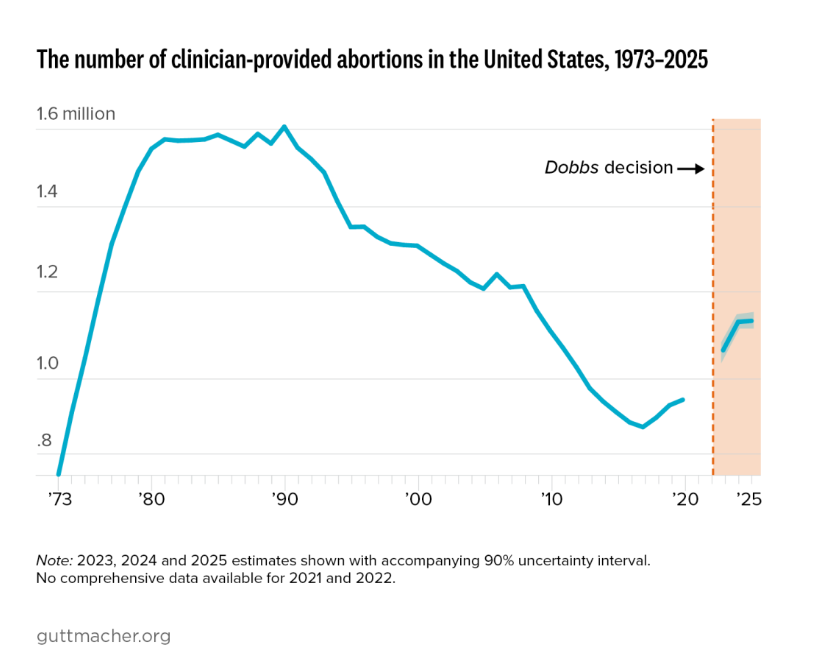
After the Roe v. Wade decision in 1973, states were prevented from protecting women and children against abortion. Over time, the number of abortions in the U.S. grew to a plateau in the 1980’s at nearly 1.6 million each year. As more pregnancy centers offered services, and restrictions such a parental consent, informed consent, and waiting periods were introduced, abortions declined steadily to about 875,000 in 2017. (1) Abstinence programs were probably also a contributing factor, as well as the prevalence of electronic entertainment and social media to reduce the number of teen pregnancies. (2)
The total number of abortions in the U.S., however, began to increase after 2017, and the increase continued after the Dobbs decision to reverse Roe v. Wade. Why?
Factors producing change
While there may be several factors contributing to the increase, the primary factors seem to be:
- Increased funding for abortion by private non-profit funds working to increase access to abortion. This funding allowed women who could not afford abortion earlier to be able to obtain them. The existence of these funds clearly testifies to the extent that abortion is accepted in our country as a woman’s right.
Abortion funds had begun to be available at least by 2000, especially in states where Medicaid did not cover abortion. The National Network of Abortion Funds (NNAF) reported that abortion funds had distributed $4.2 million in assistance in 2017. That amount more than doubled by 2020 to $9.4 million. After the Dobbs decision in 2022, donations in FY 2023 (July 2022 to June 2023) that year totaled $49 million, and $18 million in grants were disbursed. In the following year (FY 2024), however, donations to NNAF fell to $22 million and disbursements declined to $13 million. (3) If these funds continue to decline, we may see a decline in the number of abortions.
- Increasing availability of the abortion pills, and especially with the legalization of telehealth abortions in 2016. Pills were responsible for 39% of abortions in 2017, and 68% of abortions in 2023.(4) Telehealth abortions later expanded to mail-order delivery into states where abortions were banned, and distribution by retail pharmacies. Telehealth abortions increased from 3.6% in April 2022 to 28% in June 2025.(5)
- Travel to other states where abortions are legal enables many women who wanted abortions to obtain them, offsetting to some degree the effect of the bans or limits of abortion in pro-life states which were enacted after the Dobbs decision.
After Dobbs decision to reverse Roe v. Wade
After the Dobbs decision, the bans in pro-life states did prevent abortions in facilities in those states, but were offset by not only travel to other states, but continuing increases in funding and abortion pills being sold over the internet. Abortion facilities in states where abortion was legal openly shipped pills into states where abortion was limited, although that was illegal in the state they were shipped to.(6) Pro-abortion states were also refusing to extradite the doctors responsible to pro-life states for prosecution.(7) (Pills from overseas were also shipped into the U.S. at lower cost than domestic sources (8), although these were not included in abortion counts.) There are also at least 20 known incidents of male partners taking advantage of the availability of the pills over the internet by administering the pills to their partners without their knowledge or consent. (9, 10) An unknown number of similar incidents may have taken place without detection and prosecution of the men responsible.
Change in Americsn Culture to Accept Abortion
After nearly fifty years of nationally legal abortion, our culture has changed. Rather than viewing abortion as a last, extreme (and usually illegal) resort in the face of dire circumstances, abortion is now often viewed as a natural choice to end a pregnancy for any reason, that is, a woman’s ”Right to Choose” – to kill her preborn baby. The Democratic and Republican parties have become more polarized, and both legislative and executive actions regarding abortion have depended on which party was in control, both on the state and national level. The pro-life movement will continue to educate the public on the truth of abortion, and fight the protection of abortion in states where abortion is supported.
Politics Takes Precedent over Safety and Truth
A troubling fact is that the Federal Drug Administration (FDA) has failed to protect American women from serious health risks presented by the abortion pill. The approval of the drug was controversial, and safety regulations put in place in 2011 were subsequently greatly weakened over the years under Democratic administrations. Republicans have called for a re-evaluation of the original approval of the pill, as well as suing the FDA for failing its job to protect people from unsafe drugs. A recent decision by a federal district court restored the original safety regulation of requiring pills to be dispensed in person by a medical professional. The abortion pill (mifepristone) would therefore block the mailing of abortion pills. (21) The decision was quickly appealed to the Supreme Court (SCOTUS), who issued a temporary stay on the order while they consider further action. (22) This blog will continue to be updated as the process continues.
Abortion Pill Reversal (APR) is a procedure to reverse the effect of the pill to block progesterone, allowing the pregnancy to continue. May women take the pill under pressure from parents, partners, or circumstances. When the pressure disappears when the pill is swallowed, many women quickly change their mind, and want to save their baby. But here again is an even clearer case of medical experts choosing politics over scientific truth. The method is soundly based on science (11) and has saved over 8,000 babies.(12) Yet the American College of Ob-Gyns and Gynecologists (ACOG) has denied that APR is an effective and ethical procedure.(13) The American Medical Association, as well as ACOG, have treated abortion as a safe and effective procedure for health care, as well as referring to pregnancy help centers as “unethical” in the AMA medical ethics journal. (16, 17) Some states have even taken action against pregnancy centers for “giving false information” regarding the effectiveness of Abortion Pill Reversal.(18)
Goals of the Pro-Life Movement.
A key political goal of the pro-life movement at this time is to stop the distribution of the abortion pill in the mail. The next goal would be to reverse the approval of the abortion pill as a method of killing a preborn child. The original approval was lacking appropriate studies and evidence to assure safety. In addition, there is now definite evidence of harm to women. (19, 20) Considering that about 70% of abortions are now done by pill, and many of those with pills ordered online, a ban to the mailing of the pills is likely to bring significant push-back from the pro-abortion faction. Banning of the pill totally would bring even more extreme actions. We pray that violence will be avoided, and that those guilty of violence will be appropriately arrested and prosecuted. In light of the events surrounding the Dobbs decision, a peaceful transition is unlikely without significant changes in our current culture. The pro-abortion view is supported by mainstream media, as well as political figures and professional societies. It is therefore extremely important for pro-life action to increase understanding and acceptance of the pro-life view. Lies being spread must be countered with the truth. Social media posting can contribute to this change, but individual conversations would be much more effective. Information on how to have effective conversations with pro-choice friends is available here. It will certainly be many years before a national ban of abortion might be achieved.
The validity of Abortion Pill Reversal also needs to be affirmed. Even if abortion pills are blocked from mailing or even become illegal in the United States, there is likely to be an active “black market” through the mail, and the need for reversal treatment, especially in cases of coerced abortion, will still be present.
Continuing Help for Women to Choose Life – Loving Them Both
The pro-life movement will of course also continue to offer loving service to both women and their children, to help enable the choice for life. The Option Line is available 24/7 in English and Spanish to listen to women struggling with a crisis pregnancy. They have pertinent information to give, and can refer callers to a nearby pregnancy help center. While the first step is to support the decision for life, assistance continues past the pregnancy to provide both education and materials to enable a healthy and stable environment for the family. Adoption is also available as a loving plan to provide a child with a stable home when the birth parents are unable to do so. Myths and negative attitudes toward adoption must be countered with the truth.
- Guttmacher Institute, Full-Year 2025 Estimates Show Overall Stability in Abortion Incidence, Decreased Travel and Increased Telehealth Provision | Guttmacher Institute
- Fewer teenage pregnancies could be down to phone use and less drinking
- NNAF’s Annual 990’s and Annual Reports. Links for all reports are posted on https://abortionfunds.org/what-we-do/financials/. Fiscal years referred to are from NNAF’s annual reports. While the IRS Form 990 labeled 2021 has the information for July 2021 to June 2022, that period is described by NNAF as FY 2022.
- Medication Abortion Accounted for 63% of All US Abortions in 2023—An Increase from 53% in 2020 | Guttmacher Institute
- https://societyfp.org/research/wecount/wecount-june-2025-data/5
- https://www.npr.org/2024/08/06/nx-s1-5037750/abortion-pills-bans-telehealth-mail-mifepristone-misoprostol
- https://www.kff.org/state-health-policy-data/state-indicator/shield-laws/
- “Inside the Online Overseas Market for Abortion Pills”, available at https://www.nytimes.com/interactive/2023/04/13/us/abortion-pill-order-online-mifepristone.html
- https://www.40daysforlife.com/en/scumbags
- https://www.heritage.org/life/commentary/abortion-pills-coercion-and-abuse
- https://www.heartbeatinternational.org/apr-101
- https://www.heartbeatinternational.org/news-media/press-releases
- https://www.acog.org/advocacy/facts-are-important/medication-abortion-reversal-is-not-supported-by-science. Claims of the ineffectiveness of Abortion Pill Reversal cite a flawed study containing only a few women (14), while over 8,000 babies have been saved using the procedure.(12) They attack the reliability of certain studies but neglect to mention the 2018 peer-reviewed study (15) which showed a 67% success rate. They also objected to the validity of the data based on their lack of “control” subjects. A controlled experiment would involve administering a placebo pill to a group of candidates, but it would be unethical to deny some of the women the chance to save their babies.
- Why Crisis Pregnancy Centers Are Legal but Unethical | Journal of Ethics | American Medical Association (ama-assn.org)
- https://cdn.prod.website-files.com/63d954d4e4ad424df7819d46/654023a2fe63d7a736dc955e_FINAL%20-%20Complaint%20-%20Ppl%20v%20Heartbeat%20Intl%2C%20et%20al%20(APR)%20(1).pdf
- Frequently Asked Questions About the Largest Study on Chemical Abortion – Ethics & Public Policy Center
- “Physical Risks of Abortion Fact Sheet” and “Psychological Risks of Abortion Fact Sheet” from https://theunchoice.com/resources.htm
- 21. What to know about the ruling blocking the mailing of abortion pills – NBC New York
- Alito extends temporary order allowing mail distribution of abortion pill